

Research · Peer-reviewed · Case study
Clinical Gait Analysis
Estimating gait parameters from ordinary video, for remote patient care
This is research, not a client project. It comes from our founder's PhD in Applied AI and was published in IEEE Access (2024) and ICT Express (2026). It is where our work in healthcare started.
Clinical gait analysis needs equipment most patients can't get to.
Gait analysis helps clinicians follow conditions such as Parkinson's disease, stroke and osteoarthritis. The conventional route relies on costly 3D motion-capture equipment and specialist staff.
That limits who can be assessed, and how often. It also makes remote patient monitoring hard, because a patient at home can't easily step into a motion-capture lab.
The question behind this research: can useful gait measurements be estimated from an ordinary 2D video, recorded with a single camera?
From video frames to gait parameters.
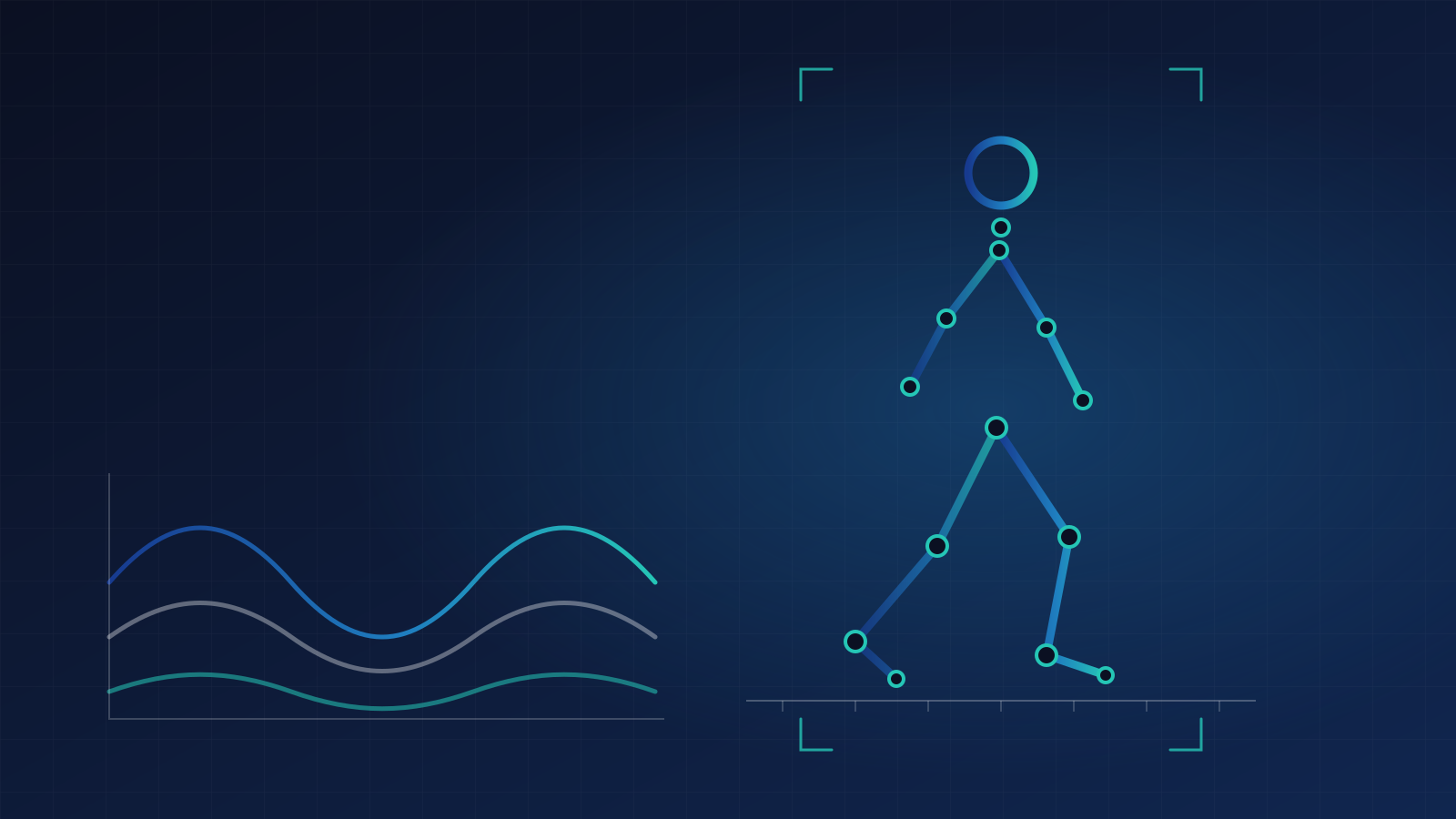
OpenPose extracts 25 body keypoints per frame from single-camera video. Those keypoints are turned into time-series input for deep learning models, which estimate four gait parameters: walking speed, cadence, peak knee flexion and the Gait Deviation Index (GDI).
The estimates are compared with the dataset's ground-truth values, using correlation, mean absolute error (MAE) and mean absolute percentage error (MAPE).
The 2026 paper compares four architectures: a Temporal Convolutional Network, a Vanilla Transformer, a Convolutional Transformer and a new hybrid LSTM-Transformer. It builds on the 2024 paper, which analysed 24 recurrent network architectures and also inferred surgical events from the estimated parameters.
What the work covers.
What the hybrid model achieved.
Hybrid LSTM-Transformer on the held-out test data, as reported in the ICT Express paper (Table 2).
| Gait parameter | MAE | MAPE | Correlation |
|---|---|---|---|
| Walking speed | 0.1397 m/s | 20.81% | 0.791 |
| Cadence | 0.090 steps/s | 11.00% | 0.790 |
| Knee flexion | 5.532° | 3.50% | 0.851 |
| Gait Deviation Index | 6.25 | 8.00% | 0.753 |
The hybrid model had the lowest MAE for speed, cadence and knee flexion, and the lowest MAPE for speed, cadence and gait deviation index, among the models compared. Its correlations were highest for knee flexion, speed and cadence; the Vanilla Transformer was slightly ahead on gait deviation index.
Against the other three architectures tested in the same study, knee-flexion error was 5.532° for the hybrid and about 35.5° for each of them, as reported in Table 2.
What these results do and don't show.
The models were trained and tested on a clinical dataset of cerebral-palsy patients recorded at a pediatric centre (ages 3.5 to 70, mean 12). The authors note this age range supports wider use, but the results are for that dataset.
Correlations of 0.75 to 0.85 are moderate, and the 20.81% error on walking speed is not small. These are research findings on recorded data. They are not a claim about performance in a clinic or in a product.
Healthcare isn't just a client vertical for us. This research is where our work with clinical data, patient monitoring and AI started.
To see how we apply that thinking to clinics and practices today, read the RTM Kinetics case study, or meet our founder.
Read the research.
- A hybrid neural network approach to gait analysis for remote patient careS. Hamid, I. Khosa, M. A. Iftikhar, M. A. Yaqub, D. Kim, M. R. Usman. ICT Express, 2026 (open access, CC BY 4.0). DOI 10.1016/j.icte.2026.01.012
- A Sequential-Data Approach for Human Gait Parameter Estimation and Surgical Event InferenceS. Hamid, I. Khosa, M. A. Iftikhar, M. R. Usman, M. A. Usman. IEEE Access, vol. 12, 2024. DOI 10.1109/ACCESS.2024.3493389
Have an idea worth building?