
SEO Is No Longer Enough: A Beginner's Guide to AEO and GEO in the Age of AI Search
For years, businesses followed a familiar digital marketing formula: choose the right keywords, create optimized pages, build backlinks, and work toward appearing on the first page of Google.
That strategy still matters. However, the way people search for information is changing. Instead of typing a few keywords and opening several websites, users are increasingly asking complete questions such as "What is the best CRM for a small service business?", "Which medical spa near me offers laser hair removal?", "How can I automate lead follow-up?", or "What is the difference between an AI agent and workflow automation?"
Search platforms can now generate a direct response, summarize information from multiple sources, and recommend businesses without requiring the user to review ten traditional blue links. Google offers AI Overviews and AI Mode, while ChatGPT can search the web and return conversational answers with links to relevant sources.
This shift does not mean SEO is dead. In fact, Google explicitly states that its generative AI search features are still built on its core search ranking and quality systems. Strong technical SEO, useful content, crawlability, and authority remain essential.
The difference is that businesses must now optimize for more than rankings. They must also optimize to become the direct answer, a trusted source used in an AI-generated response, and a business that an AI platform feels confident recommending. That is where AEO and GEO enter the picture.
What Is Traditional SEO?
SEO stands for Search Engine Optimization. It is the process of improving a website so that search engines can understand, index, and rank its pages for relevant searches. Traditional SEO usually involves four main areas.
Technical SEO
Technical SEO ensures that search engines can properly access and process your website. This includes fast page loading, mobile-friendly design, crawlable pages, correct indexing, secure HTTPS connections, clean site architecture, canonical URLs, XML sitemaps, and structured data where appropriate. A great article cannot generate organic traffic if search engines cannot reliably discover or index it.
On-Page SEO
On-page SEO helps search engines and visitors understand what each page covers. It includes descriptive page titles, useful headings, relevant keywords, clear URLs, internal links, image alt text, well-written meta descriptions, and content that satisfies search intent.
Off-Page SEO
Off-page SEO focuses on signals outside your website. Backlinks, brand mentions, reviews, directory profiles, partnerships, and media coverage can help establish authority and trust.
Content SEO
Content SEO involves publishing useful resources that answer the questions your target audience is already asking — service pages, comparison guides, tutorials, case studies, frequently asked questions, industry reports, and original research.
SEO helps your website become discoverable. However, modern search systems do more than rank pages — they interpret, summarize, compare, and recommend information.
What Is AEO?
AEO stands for Answer Engine Optimization. It is the practice of structuring content so that search engines and AI assistants can easily identify a clear, useful answer to a user's question.
Traditional SEO may focus on ranking a page for lead follow-up automation. AEO focuses on clearly answering: what is lead follow-up automation, how does it work, and when should a business use it?
Answer engines may include Google featured snippets, Google AI Overviews, voice assistants, ChatGPT search, Bing Copilot, and other question-and-answer platforms. AEO does not require you to abandon keywords. It requires you to understand the questions behind those keywords.
What AEO-Friendly Content Looks Like
AEO-friendly content normally provides a direct answer before expanding into detail. For example: What is lead follow-up automation? Lead follow-up automation is a system that automatically responds to, qualifies, nurtures, and routes new enquiries using tools such as email, SMS, CRM updates, and internal notifications.
That definition is easier for both a human reader and an automated system to identify than an introduction containing several paragraphs of general marketing language. Effective AEO content often includes question-based headings, short definitions, step-by-step explanations, comparison sections, concise summaries, FAQ sections, descriptive examples, and clear supporting evidence.
The objective is not to make every paragraph robotic or unnaturally short. Google specifically says there is no requirement to break content into tiny chunks or rewrite every page in a special style for generative AI. Content should still be written primarily for people.
What Is GEO?
GEO stands for Generative Engine Optimization. It describes efforts to increase the likelihood that a brand, website, product, or piece of content will be discovered, trusted, cited, or recommended in AI-generated answers.
A traditional search engine may display ten links. A generative system may instead produce one combined answer using information retrieved from several sources. This changes the visibility goal — your business may not only be competing for position number one, it may also be competing to become one of the sources that informs the answer.
GEO Is About Being a Trustworthy Source
Generative systems need content they can confidently interpret and use. That makes clear expertise, first-hand experience, original examples, accurate company information, consistent brand details, strong service pages, author credentials, independent reviews, relevant third-party mentions, case studies with specific methodology, and up-to-date statistics with sources increasingly valuable.
Generic content is easy to create and easy to replace. Original content based on real business experience is more difficult to reproduce. Google's current guidance recommends creating unique, non-commodity content that offers first-hand knowledge or a distinctive point of view instead of simply summarizing what already exists online.
For example, an article titled "Five Benefits of Automation" may provide little new information. A stronger GEO-focused article could be "How We Designed a Lead Follow-Up System That Connects Website Forms, SMS, Email, CRM Records and Sales Notifications." The second topic contains real processes, specific systems, implementation knowledge, and lessons learned — giving people, and potentially AI systems, a stronger reason to reference it.
SEO vs AEO vs GEO: What Is the Difference?
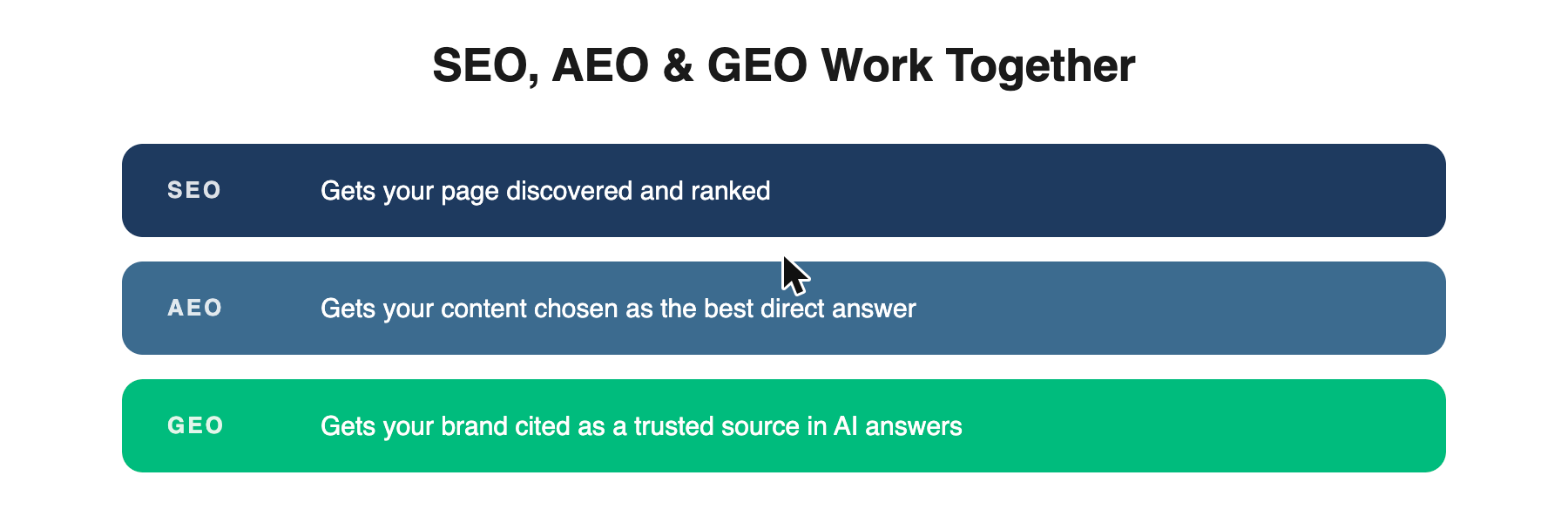
The simplest way to understand the three is: SEO helps your page get discovered and ranked. AEO helps your content provide the best direct answer. GEO helps your brand and content become a trusted source in generative AI responses.
They are not three completely separate marketing strategies — they overlap. Google considers optimization for its generative AI experiences to be part of SEO rather than an entirely separate discipline. It also warns businesses against unsupported "AEO hacks" or "GEO hacks," such as creating unnecessary AI-specific files, publishing low-value pages at scale, or buying artificial mentions.
A practical strategy therefore looks like this: build a technically strong website, publish useful pages targeting genuine customer needs, answer important questions clearly, demonstrate experience and authority, make your business information consistent and verifiable, earn recognition beyond your own website, and monitor how users discover and engage with your content.
Why AI Search Changes the Customer Journey
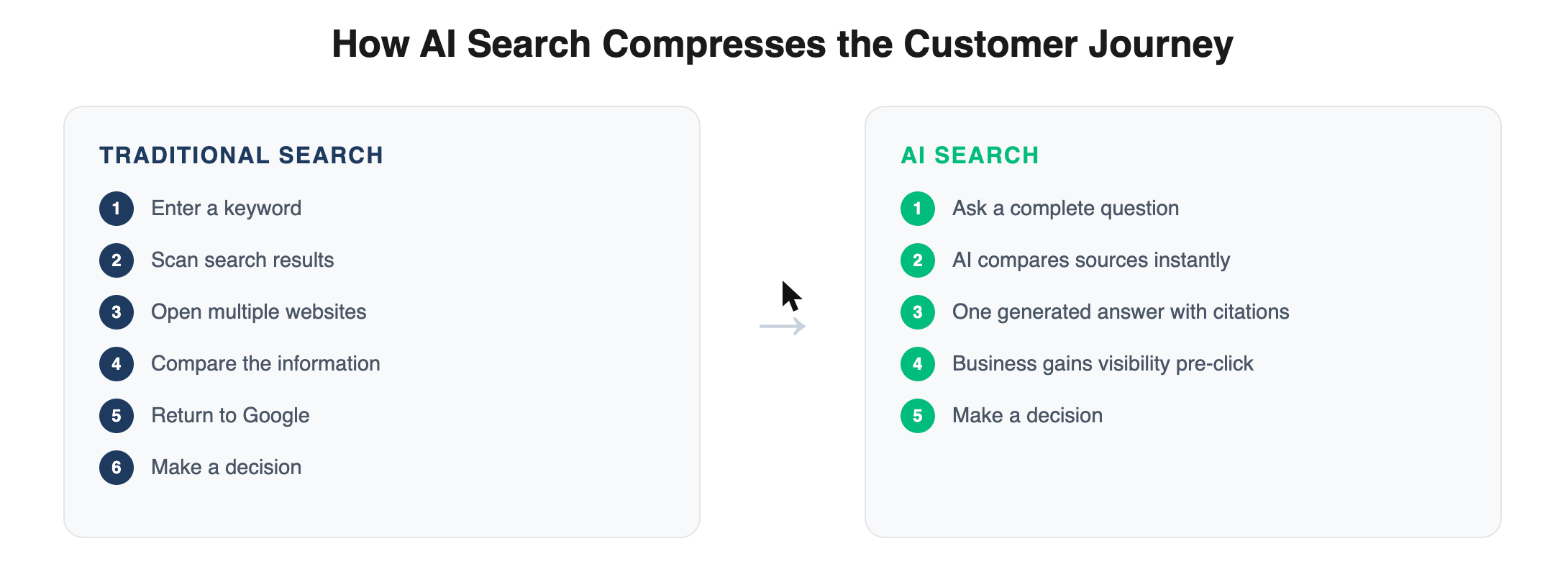
Traditional search often requires users to complete several steps: enter a keyword, scan the search results, open multiple websites, compare the information, return to Google, and make a decision.
AI search can compress this journey. A user may ask "What is the best way for a medical spa to respond to leads outside business hours?" The AI system may explain possible solutions, compare email and SMS follow-up, discuss CRM integration, and provide links to selected sources. The businesses included in that answer gain visibility before the user has visited a traditional list of search results.
This is why being merely indexed is no longer the full goal. Your content must make your business understandable, credible, and easy to recommend.
How to Optimize Your Website for SEO, AEO and GEO
1. Start With Real Customer Questions
Talk to your sales, support, and operations teams. Identify the questions customers ask before buying, such as how much the service costs, how long implementation takes, whether it will work with existing software, what tasks to automate first, whether they need an AI agent or a standard workflow, and how they will measure return on investment.
Create pages that answer these questions honestly and completely. Do not publish twenty nearly identical pages simply to target minor keyword variations — one strong page that addresses the full topic is usually more useful than multiple thin pages.
2. Answer the Main Question Early
Do not force readers to scroll through a long introduction before receiving an answer. Use a simple structure: direct answer, explanation, example, limitations, next step. This improves readability and makes the page easier to interpret.
3. Publish First-Hand Expertise
Your strongest content already exists inside your business — in project documentation, client questions, implementation decisions, failed experiments, internal processes, sales conversations, performance reports, and case study results. Turn that knowledge into useful content. Instead of repeating general advice, explain what your team has learned from building and operating real systems.
4. Create Detailed Case Studies
A useful case study should explain the client's original problem, the systems involved, the proposed architecture, the implementation process, important constraints, how errors and exceptions were handled, the result, and what the team learned. Avoid unsupported claims. Use verified numbers where they are available — when exact figures are confidential, describe the operational improvement without inventing percentages.
5. Strengthen Your Brand Entity
An AI system should be able to understand that your company is a real organization offering specific services. Keep your business name, services, address, phone number, leadership information, industry focus, social profiles, Google Business Profile, author biographies, and contact details accurate and consistent. For local and service businesses, Google recommends maintaining accurate business details through tools such as Google Business Profile.
6. Use Structured Data Correctly
Structured data helps search engines interpret certain page elements and can make pages eligible for rich search features. Depending on the website, appropriate schema may include Organization, LocalBusiness, Article, BreadcrumbList, Product, Service, Review, and FAQ-related markup where supported. However, structured data is not a shortcut to AI visibility — Google states that no special schema is required for its generative AI features. Structured data should accurately represent the visible content of the page and remain part of a broader SEO strategy.
7. Make Your Website Easy to Crawl
Your content cannot be selected if systems cannot access it. Review robots.txt rules, noindex tags, canonical settings, JavaScript rendering, internal links, page status codes, sitemap accuracy, and mobile performance. Businesses should also understand that different AI platforms may use different crawlers and controls — OpenAI, for example, provides publisher guidance concerning OAI-SearchBot and referral tracking from ChatGPT.
8. Build Authority Beyond Your Website
A company describing itself as excellent is not the same as independent sources confirming its expertise. Useful authority signals may include genuine customer reviews, industry partnerships, podcast appearances, expert contributions, relevant business directories, conference participation, original research referenced by others, client testimonials, and earned media coverage. Avoid purchasing artificial mentions or publishing low-quality guest posts purely to manipulate visibility — search and AI systems continue to invest in detecting spam and low-quality content.
9. Keep Important Content Current
AI systems and search engines need accurate information. Regularly review pages containing product capabilities, pricing, team information, software integrations, industry regulations, technical instructions, statistics, and tool comparisons. Add a visible update date when it provides value, but do not change the date without meaningfully updating the content.
10. Measure Business Results, Not Just Rankings
Traditional rank tracking alone does not tell the full story. Monitor organic impressions, click-through rate, qualified enquiries, assisted conversions, branded searches, referral sources, landing-page engagement, demo bookings, Search Console data, and mentions and citations in AI platforms. Google now recommends using Search Console's generative AI reporting capabilities to understand discovery through its AI search features where those reports are available.
The final objective is not to appear in an AI answer for vanity. The objective is to attract relevant customers and turn visibility into measurable business growth.
Common AEO and GEO Mistakes
Treating SEO as obsolete. AI search still depends heavily on discoverable, technically accessible, high-quality web content. Ignoring SEO makes AEO and GEO harder, not easier.
Publishing large amounts of generic AI content. Producing hundreds of low-value articles does not create authority. Content should add experience, analysis, examples, or original information that is not already available everywhere.
Optimizing only for machines. Awkward definitions, repetitive keywords, and unnatural formatting create a poor reader experience. Write for customers first. Make the structure clear enough that search and AI systems can also understand it.
Expecting guaranteed AI citations. No agency or software platform can guarantee that a particular AI system will cite a specific website for every query. Results can change depending on the user, location, wording, model, index, and available sources. A responsible strategy improves eligibility, relevance, clarity, and trust — it does not promise control over an external platform.
The Future of Search Is Multi-Platform
Customers may discover your company through Google Search, Google Maps, Google AI Overviews, ChatGPT, Gemini, Copilot, Perplexity, YouTube, Reddit, industry publications, and social platforms.
Businesses should not build their entire visibility strategy around one algorithm. The better approach is to develop a strong digital presence that is technically accessible, genuinely helpful, clearly differentiated, and trusted across multiple channels.
Final Takeaway
SEO is not disappearing. It remains the foundation that makes your website accessible and discoverable. However, rankings are no longer the only form of visibility.
AEO helps your content become a useful direct answer. GEO helps your brand become a credible source in AI-generated experiences. Together, they create a more complete search strategy for a world where customers increasingly expect answers instead of lists of links.
The businesses that benefit most will not be those chasing every new optimization trick. They will be the businesses publishing clear, original, trustworthy information that deserves to be found, cited, and recommended.
Frequently Asked Questions
Is SEO being replaced by AI search? No. SEO remains essential because AI search systems still need accessible and reliable information. Google states that its generative AI features use its core search ranking and quality systems. AEO and GEO should therefore extend your SEO strategy rather than replace it.
Can a business rank in ChatGPT? ChatGPT does not operate like a traditional search ranking page with fixed numbered positions. Businesses can improve their chances of being discovered or cited by publishing accessible, authoritative, relevant content and maintaining accurate brand information. Inclusion is not guaranteed.
Do I need an llms.txt file for GEO? Google states that llms.txt does not improve or harm visibility in Google Search or its generative AI features. Other services may adopt different approaches, so implementation should be based on a documented platform requirement rather than marketing claims.
Is AEO only about FAQ pages? No. FAQs can help, but AEO applies to service pages, guides, product pages, case studies, comparison articles, support documentation, and any content that clearly answers a user's question.
How long does AEO or GEO take? There is no universal timeline. Results depend on the website's technical health, authority, competition, content quality, industry, and how quickly search platforms discover and process changes.
Build a Search Strategy for the AI Era
CodeSquad helps businesses connect technical SEO, content systems, marketing intelligence, automation, AEO, and GEO into a measurable growth engine. Instead of chasing isolated AI-search tricks, we focus on building a strong digital foundation that helps your business get discovered, understood, and trusted across traditional and generative search.
Book a free discovery call to identify where your website is losing visibility and what your highest-impact search opportunities are.