
Your SaaS Is Being Recommended by AI — But Is It Being Recommended to Your Customers?
For years, SaaS companies played a familiar game: rank on Google, get the click, and win the customer.
But that customer journey is changing. Today, a potential customer might skip traditional search entirely and ask an AI assistant, “Which tool should I use?” The assistant may recommend three of your competitors while your company is not mentioned at all.
There is no bounce in your analytics, no abandoned trial, and no lead disappearing from your CRM. You never even know that potential customer existed.
You didn't lose the deal. You were never in the room.
That is the shift SaaS companies need to understand.
The SEO Game Has Changed
For roughly two decades, the basic search strategy was straightforward: rank, get the click, convert the visitor, and win the customer. SEO teams focused on making sure search engines could discover their pages and understand that their content was relevant.
AI-powered discovery introduces a different question: Can an AI system understand your company well enough to confidently recommend it?
Before reaching a traditional search results page, buyers may now ask an AI assistant to narrow down their options. Instead of visiting dozens of websites, they can ask which software is best for their business, which platform is suitable for a small team, what the best alternatives are, or how several SaaS products compare.
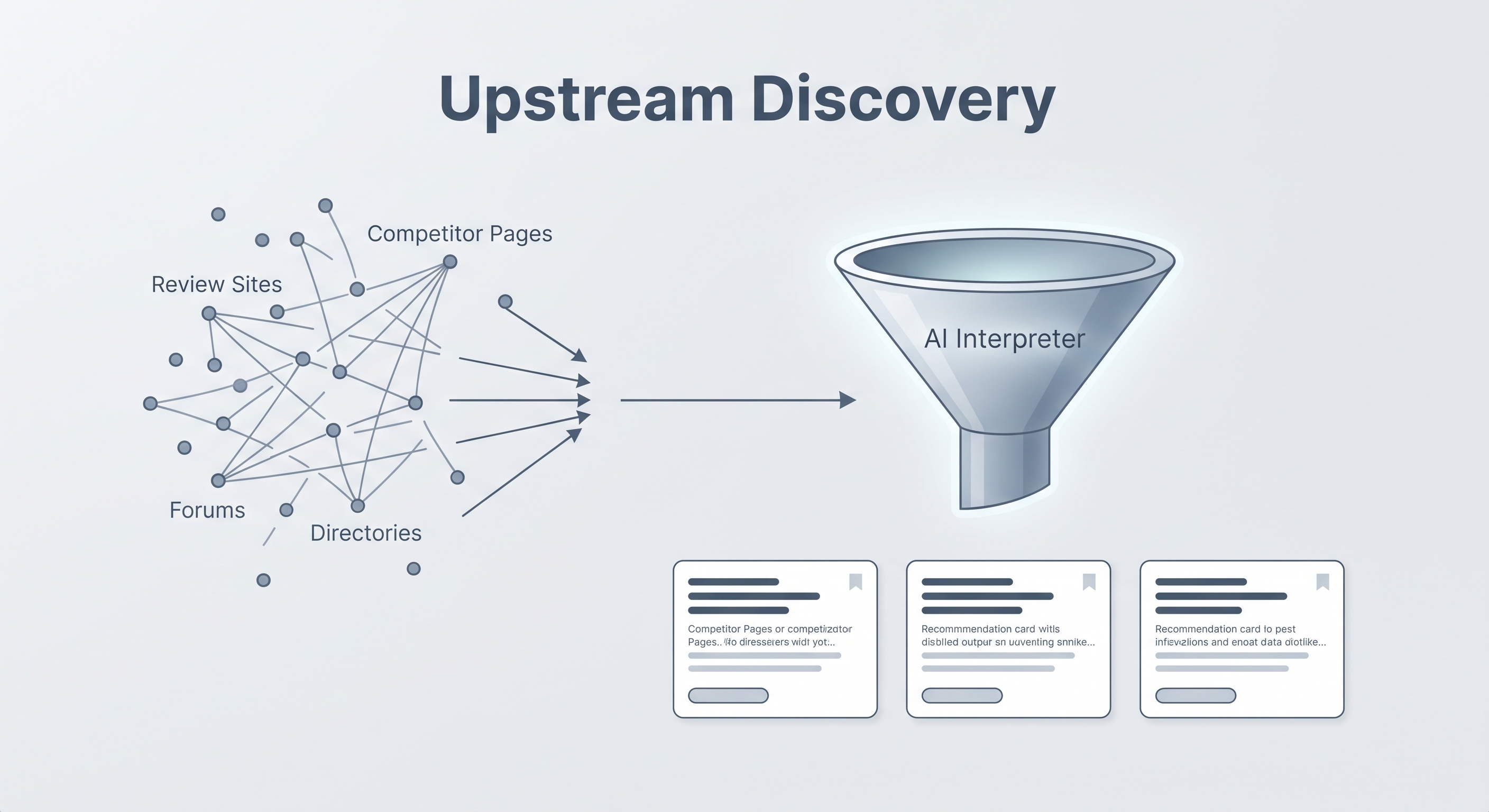
The AI can then turn a large amount of research into a short recommendation. In other words, discovery has moved upstream. The AI is becoming an interpreter between your company and your potential customer.
This creates an important challenge: ranking number one on Google does not automatically mean an AI assistant will recommend you.
Why SaaS Is Especially Vulnerable
SaaS companies are particularly exposed to this change because software purchases naturally involve comparison. Buyers want to understand which product is better for their situation, how much each option costs, what features are available, and which solution fits their needs.
AI assistants are naturally suited to these questions. However, the information they use may not come directly from your website. Review platforms, industry publications, directories, communities, podcasts, customer reviews, and comparison websites can all influence how your product is understood.
If these third-party sources explain your product more clearly than you do, they can become the information layer through which AI understands your company.
AI also compresses the SaaS buying journey. A purchase that previously required weeks of research across multiple websites can potentially be reduced to a short AI-generated summary and a shortlist of products. That makes the quality, clarity, and availability of information about your company increasingly important.
The 7 Strategies to Get Your SaaS Recommended by AI
The good news is that SaaS companies can take practical steps to make their products easier to understand and more useful as a recommendation.
1. Write in Extractable Units
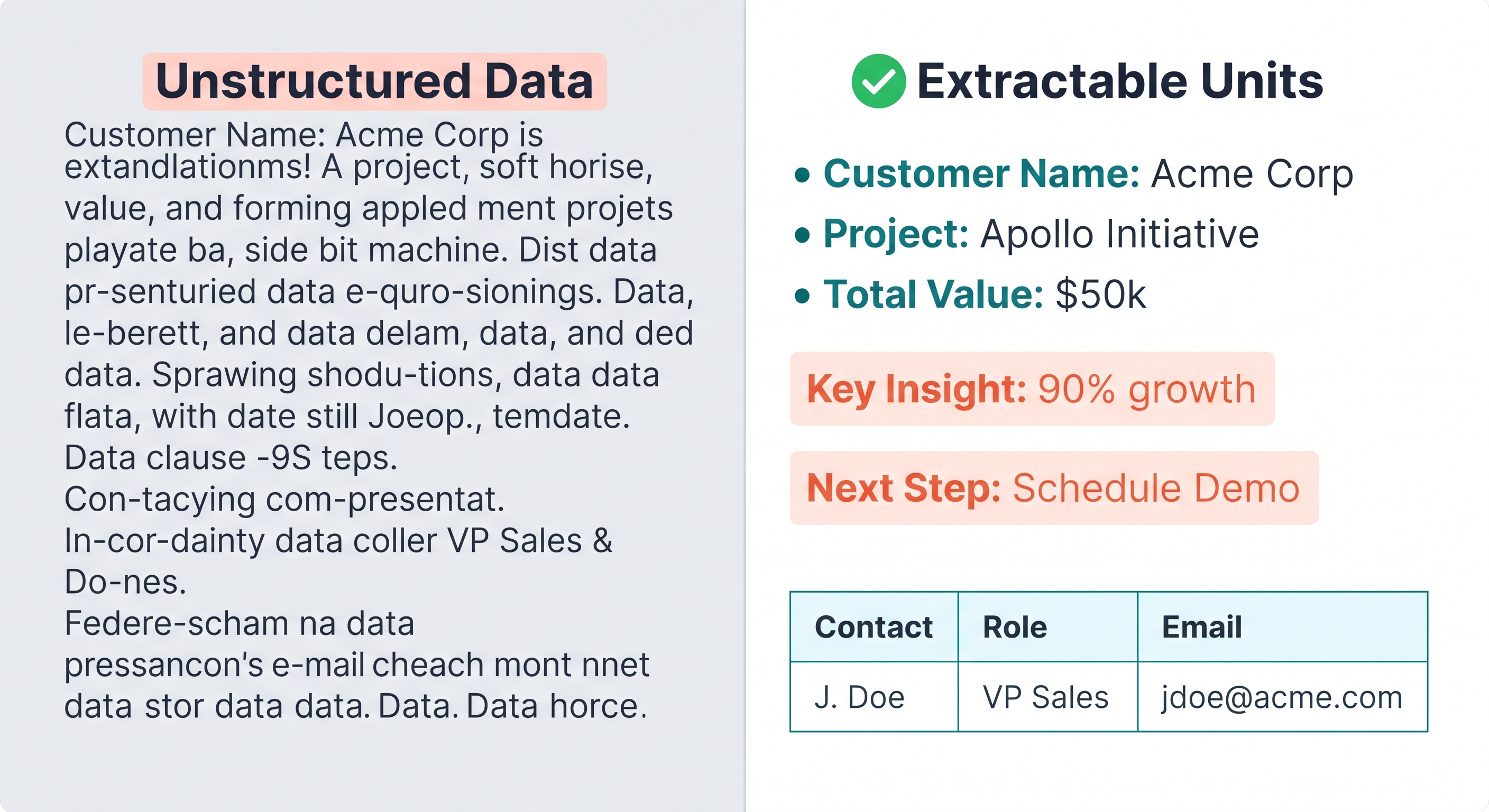
Your most important product information should be easy to find, understand, and interpret. Instead of burying an important answer deep inside a long paragraph, place the answer near the beginning of the relevant section and use clear headings that explain exactly what the reader will find.
Product specifications, use cases, pricing information, integrations, and target customers should be presented through concise explanations, tables, structured comparisons, or direct statements. For example, clearly stating that a product is best suited for mid-sized businesses, focuses on workflow automation, offers 100+ integrations, and has plans within a defined pricing range is much easier to understand than hiding those details inside several paragraphs.
The principle is simple: if an AI can identify a clear claim quickly, it has something useful to work with. Clear information also makes the page easier for human readers to scan.
2. Publish Original Data
One of the strongest ways to make your company a valuable source of information is to publish data that other companies cannot easily reproduce. This could include anonymized usage statistics, industry benchmarks, customer trends, adoption data, product usage insights, performance benchmarks, or survey results.
For example, a SaaS company could publish an annual industry benchmark report based on anonymized product usage. Instead of simply making another marketing claim, the company becomes the source of original information that others can reference.
Don't just become another company making claims. Become the source of the numbers.
3. Own Your Comparison and Alternatives Pages
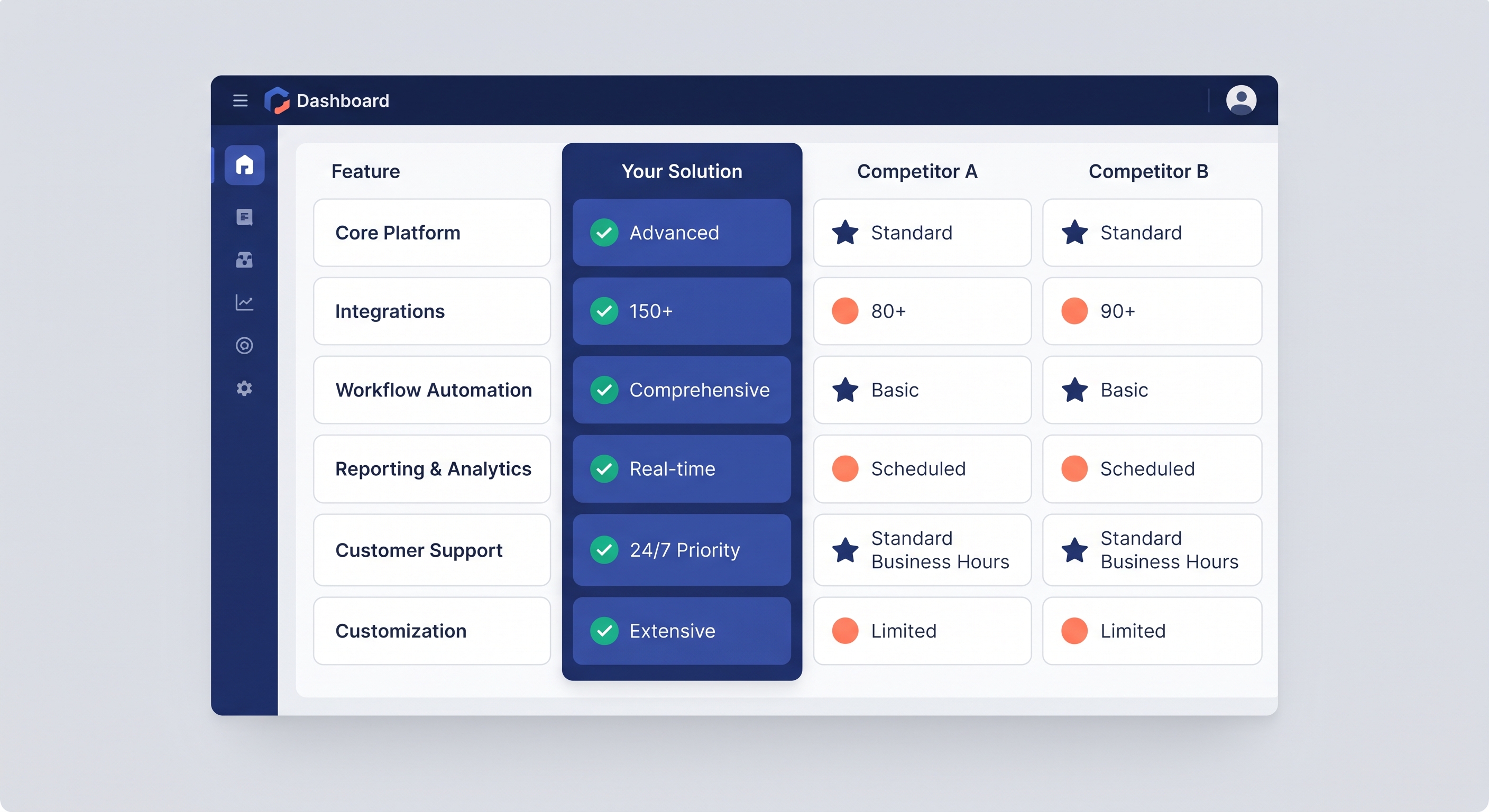
Comparison and alternatives content can play an important role because software buyers naturally compare products before making a decision. Create useful pages comparing your product with major competitors, explaining alternatives, comparing pricing and features, and showing which tools are best suited for specific use cases.
The key is to remain objective. A comparison page that claims your product wins in every category is less useful than one that honestly explains where each product performs well and who should choose it.
For example, you might explain that your product is designed for SMBs, offers advanced automation, has 100+ integrations, and includes a free plan, while one competitor focuses more heavily on enterprise customers and another provides simpler automation for smaller teams.
The goal is not to pretend your product is always the best option. The goal is to provide useful information that helps buyers understand which solution is right for their needs.
4. Make Your Pricing Accessible
Price is one of the first questions buyers ask, and it is also a common question asked of AI assistants. If your website provides no useful pricing information, another company with clearer pricing may have an advantage.
If you can publish exact pricing, make it available. If exact pricing is not possible, provide useful information such as starting prices, pricing ranges, plan structures, seat minimums, per-user costs, feature differences, or guidance for enterprise customers.
Don't make customers jump through unnecessary hoops just to understand whether your product fits their budget.
5. Show Your Experts
People need to know who is responsible for the information they are reading. Connect your content and claims to identifiable people by using real author names, professional credentials, relevant experience, expert quotes, author profiles, and a detailed About page.
If you publish research, explain who conducted it and how it was created. If an expert makes an important claim, identify that expert and provide relevant context.
Your company should make one thing clear: who is behind this information, and why should anyone trust them?
6. Build a Presence Beyond Your Website
Your website is only one part of your digital presence. Information about your company can also appear across review platforms, industry publications, communities, podcasts, directories, partner websites, customer reviews, and professional platforms.
Make sure your company description, product category, features, and other important information remain accurate and consistent across these sources. Genuine customer reviews and credible third-party mentions can help create a stronger digital footprint.
The goal is not to manufacture positive reviews or manipulate external platforms. It is to make sure that when someone—or an AI system—researches your company, they find a reliable and accurate representation.
Your brand exists beyond your domain.
7. Define Your Category in Your Customer's Words
Don't make customers or AI systems guess what your company does. Clearly explain the problem you solve, who you solve it for, how the problem is measured, what alternatives exist, and where your product fits into the market.
Most importantly, describe the problem using language your customers actually use. Internal marketing language can sometimes make a simple product sound unnecessarily complicated.
For example, instead of describing your product as an “intelligent workflow orchestration platform,” explain it in simpler terms: “software that automates repetitive tasks between your business tools.”
Clear language makes your product easier for both customers and information systems to understand.
A Practical 90-Day Plan
You don't need to implement all seven strategies at once. A simple 90-day plan can help you build the foundation without overwhelming your team.
Days 1–30: Audit
Start by asking AI assistants the same questions your customers are likely to ask. Ask which software is best for a particular problem, what the best alternatives to a competitor are, which tool is best for a specific customer type, or how your company compares with another product.
Record which companies appear, which companies are missing, how your company is described, whether the information is accurate, and which sources are being referenced. This gives you a baseline for understanding your current visibility.
At the same time, review your highest-intent pages. Look at your product, pricing, comparison, alternatives, feature, and use-case pages. Check whether they provide clear answers, useful specifications, accessible pricing, identifiable authors, and enough information for someone to understand your product without unnecessary effort.
Days 31–60: Fix and Publish
Once you understand the gaps, improve the pages that matter most. Strengthen your product pages, pricing pages, comparison pages, alternatives pages, feature pages, use-case pages, author profiles, and About page.
Then publish at least one piece of original research. Focus on producing something genuinely useful rather than simply increasing your content volume. Original data can give your company information that others can reference and discuss.
Days 61–90: Amplify
Your research should not remain hidden on your website. Put it in front of relevant audiences through industry publications, communities, podcasts, partnerships, expert interviews, and professional networks.
At the same time, review your external profiles and correct outdated or inconsistent information. After 90 days, repeat the AI questions you used during your initial audit and compare the results with your original baseline.
Stop Measuring AI Visibility by Traffic Alone
Traffic is still important, but it should not be the only metric you monitor. Start paying attention to your share of AI mentions and how accurately your company is represented.
Look at how often your company appears in relevant recommendations, whether it is described correctly, whether the right products and use cases are associated with your brand, whether branded searches are increasing, and whether AI-referred visitors are converting.
A company can have strong AI visibility without immediately receiving massive referral traffic. The bigger objective is becoming part of the consideration set when buyers begin evaluating their options.
5 Ways to Blow Your AI Visibility Strategy
1. Publishing Thin, Low-Value Content
Don't create content simply to increase your publishing volume. Focus on information that genuinely helps buyers understand a problem, compare solutions, or make a decision.
2. Putting Your Best Information Behind Forms
Your most important product information should be accessible. If buyers cannot understand your product without submitting a form, you make it harder for both customers and information systems to discover the information they need.
3. Hiding Your Pricing
Give potential customers enough pricing information to understand whether your product is likely to fit their needs and budget. Even when exact pricing cannot be published, useful ranges or plan guidance are better than complete uncertainty.
4. Ignoring Incorrect AI Information
If an AI assistant describes your company incorrectly, don't ignore it. Investigate the information available online, identify where the misunderstanding may come from, and make accurate information about your company clearer and more consistent.
5. Abandoning Traditional SEO
AI discovery does not mean traditional SEO is dead. Technical SEO, useful content, authority, and a strong website still matter. The difference is that SEO is no longer the entire discovery journey.
Search Didn't Die. It Got an Interpreter.
Search has not disappeared. It has gained another layer.
There is now an interpreter between your company and your potential customer. That interpreter may take everything it knows about your company and turn it into a short recommendation that influences what the buyer considers next.
Your product, positioning, pricing, strengths, weaknesses, competitors, and reputation can all be compressed into a few sentences. Your job is to give that interpreter something accurate, useful, clear, and credible to say.
That means making your product easier to understand, publishing original data, creating honest comparisons, making pricing accessible, showing your experts, building a presence beyond your website, and defining your category in the language your customers actually use.
Because the question is no longer simply:
“Can people find us?”
The new question is:
“When our ideal customer asks an AI for a recommendation, does the AI understand us well enough to mention us?”
That is the new challenge for SaaS companies. For companies that adapt early, it can become a meaningful competitive advantage.
Find Out What AI Is Saying About Your SaaS
The first step isn't guessing. Ask the questions your customers actually ask and see what different AI assistants recommend. Look at which competitors appear, whether your company appears, and most importantly, how your company is described.
This gives you a starting point for improving your visibility throughout the new AI-powered discovery journey.
If you want help mapping this strategy to your SaaS product, book a free 30-minute call and bring the questions your buyers actually ask.
Let's find out what AI has been saying about your company—and what you can do about it.