
SEO Isn't Dead — But Your SaaS SEO Playbook Probably Is
AI SEO for SaaS: How to Rank in Google and Get Recommended by ChatGPT, Claude, and AI Overviews
Key Takeaways
Software discovery has moved upstream. Many buyers now use AI assistants before traditional search, so your first impression may be a sentence generated about your company.
Rankings and AI citations are different. A page can rank highly in Google and still be absent from an AI-generated recommendation.
AI assistants favor content that is easy to understand and verify. Clear structure, original data, named experts, transparent pricing, and credible third-party sources make information easier to cite.
Comparison, alternatives, and pricing pages are high-value assets. These pages directly answer the questions buyers commonly ask AI assistants.
Measure more than traffic. Track AI mentions, citation accuracy, branded search growth, referral traffic, and assisted signups.
The SEO Problem That Never Shows Up in Your Analytics
Picture your ideal buyer. The budget is right, the team size is right, and the problem matches your product.
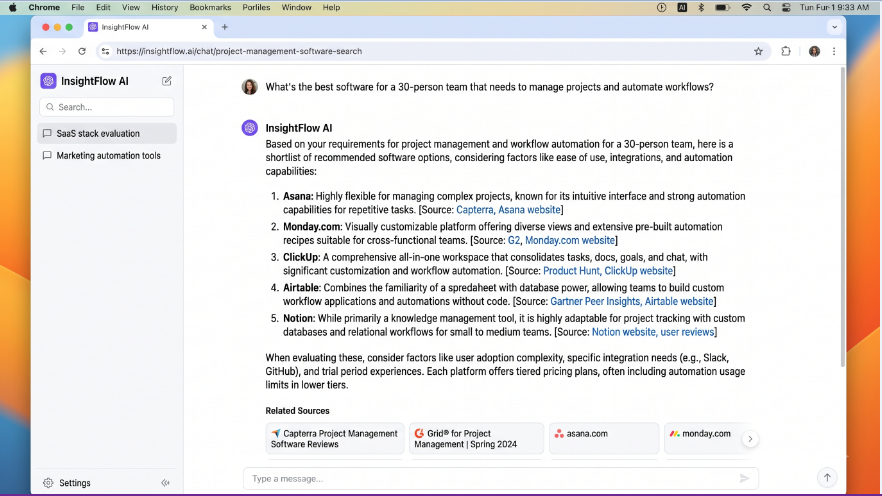
On Tuesday morning, they open a chatbot and ask: "What's the best tool for a 30-person team that needs X?"
Seconds later, they have a shortlist of five products and a reason for each.
You aren't on the list.
There is no bounce in your analytics, no abandoned trial, and no lost deal recorded in your CRM. The customer simply never learned you existed, while a competitor was recommended instead.
Why SaaS SEO Is Especially Affected
SaaS is particularly exposed to AI-driven search because software discovery naturally involves comparison, research, and evaluation.
1. Software Questions Are Perfect for AI Assistants
"Which CRM is best for a 12-person agency?" is a comparison question with a defined set of options and evaluation criteria. That's exactly the type of question AI assistants can answer quickly.
2. Aggregators Already Have Strong Authority
Review platforms and software directories already have significant authority. They can also become important sources for AI-generated software recommendations. If your product is missing from these platforms, you may be missing opportunities to be discovered.
3. SaaS Buying Cycles Involve Extensive Research
SaaS purchases often involve multiple stakeholders and many research touchpoints. AI can compress the early research stage, making it more important for your content to communicate value clearly and quickly.
Traditional SEO vs. AI SEO: Two Scoreboards, One Strategy
Traditional SEO asks: Can a search engine find this page and determine that it is relevant and authoritative?
AI search optimization asks: Can an AI system understand this page, extract a useful claim, and confidently associate that claim with your company?
The overlap is significant, but AI discovery puts more emphasis on clarity, structure, extractability, and verifiable information.
A page can rank well in Google without being mentioned in an AI answer, while a well-structured page with clear comparisons, evidence, and a named author may be easier for an AI system to use.
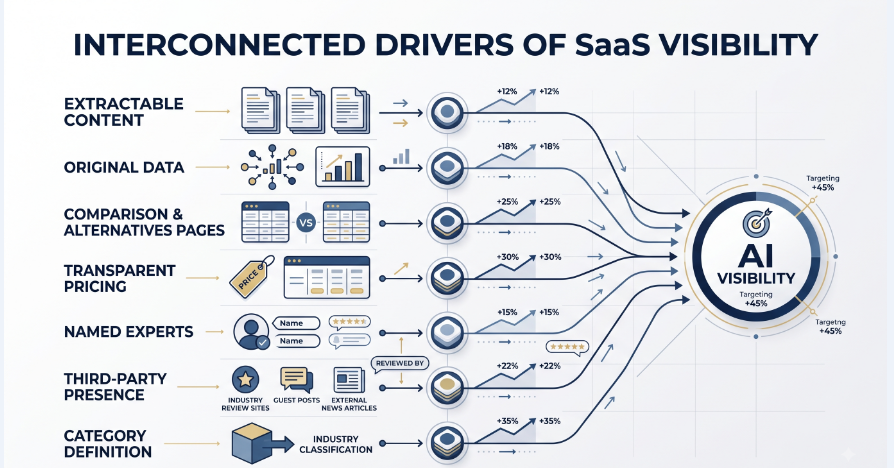
7 AI SEO Tactics That Can Earn Citations
1. Write in Extractable Units
AI systems can more easily use content when the main answer is clear and supported by the surrounding explanation.
Rewrite rule: Put the answer near the beginning of each section. Use descriptive H2s and H3s, and organize specifications, pricing, limits, and comparisons into tables and lists where appropriate.
2. Publish Original Data
Original research gives your company information that other websites cannot simply reproduce. SaaS companies can use anonymized usage data, benchmarks, adoption trends, or industry research to create distinctive content.
A focused report containing real data can be more valuable than a long guide that simply summarizes information already available elsewhere.
3. Own Your Comparison and Alternatives Pages
When buyers ask an AI assistant how your product compares with a competitor, comparison content can provide useful context.
Good comparison pages should explain where each product performs well, where it falls short, and how the products differ. Objective comparison tables are generally more useful than pages written entirely as sales copy.
4. Make Pricing Information Accessible
Pricing is an important factor in software recommendations. If exact pricing cannot be published, consider providing ranges, plan structures, seat requirements, or details about what each tier includes.
The goal is to give potential buyers enough information to understand whether your product fits their budget.
5. Show Your Experts
Named authors, relevant credentials, expert quotes, methodology notes, and a clear company About page can strengthen the credibility of your content.
Content is easier to trust when readers can understand who created it and why they are qualified to discuss the subject.
6. Build a Strong Third-Party Presence
Your website is only one source of information about your company. Review platforms, industry publications, community discussions, podcasts, and software directories can also influence how your brand is discovered and described.
Keep your profiles accurate, encourage genuine customer reviews, and pursue relevant third-party coverage.
7. Define the Category You Want to Be Found In
Use the language your customers use to describe their problems and solutions. Explain the problem, how it is measured, available alternatives, and where your product fits.
Clear category-focused content helps both search engines and AI systems understand what your product does and who it serves.
Your 90-Day SaaS SEO Rollout Plan
Days 1–30 — Baseline and Audit
Ask ChatGPT, Claude, Perplexity, and Google AI features the questions your buyers actually ask. Record which brands appear and which sources are cited.
Then audit your most important pages. Check whether answers are easy to find, information is well structured, tables are used where helpful, and authors are clearly identified.
Days 31–60 — Fix and Publish
Improve your highest-intent pages. Create or update comparison and alternatives pages, make pricing information clearer, add author information, and begin an original research project.
Days 61–90 — Expand and Amplify
Publish your research and promote it through relevant industry publications and communities. Refresh your third-party profiles and repeat your AI-search tests to see whether your visibility and brand descriptions have improved.
How to Measure SEO Success in the AI Era
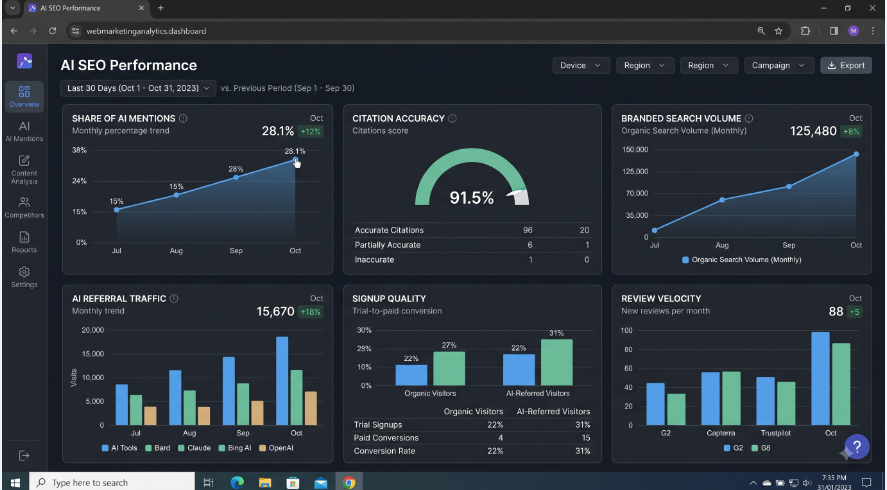
Traffic alone does not tell the full story. If AI answers satisfy some informational searches without a click, sessions can decline while higher-intent traffic and conversions remain strong.
Track these metrics:
| Metric | What It Tells You |
|---|---|
| Share of AI mentions | How often your company appears across a fixed set of prompts |
| Citation accuracy | Whether AI assistants describe your product correctly |
| Branded search volume | Whether AI exposure is increasing branded demand |
| AI referral traffic | How much direct traffic comes from AI platforms |
| Signup quality | How AI-referred or organic visitors convert |
| Review velocity | How quickly your third-party review presence is growing |
Use a consistent prompt set and test it regularly. Consistency makes changes easier to measure.
5 SaaS SEO Mistakes That Quietly Hurt Visibility
- Mass-producing thin content. More pages do not help if they provide little original value.
- Gating your best content. Content hidden behind forms is harder for search engines and AI systems to access.
- Hiding pricing. Limited pricing information can make your product harder to evaluate.
- Ignoring inaccurate AI descriptions. If AI systems misunderstand your product, improve the clarity and consistency of the information available online.
- Abandoning traditional SEO. Technical SEO, quality content, authority, and strong rankings still matter.
SaaS SEO FAQs
Is SEO dead for SaaS companies?
No. SEO remains important, but the search journey is changing. Strong technical SEO and useful content can support both traditional search visibility and AI discovery.
How Is AI Search Optimization Different From Regular SEO?
Traditional SEO focuses heavily on relevance, authority, and earning clicks. AI search optimization also emphasizes clear structure, extractable information, original evidence, and verifiable claims.
Can I Pay to Appear in AI Answers?
Organic recommendations are different from paid placements. Some AI products may offer advertising or sponsored placements, but these are separate from organic citations and recommendations.
How Long Before I See Results?
Some structural improvements can have an impact relatively quickly, while authority-building activities such as earning reviews, publishing research, and gaining third-party coverage typically take longer.
What If an AI Tool Describes My Product Incorrectly?
Make the correct information clear and current across your website and relevant third-party profiles. Consistent, accessible information gives AI systems better evidence to work with.
The Bottom Line
The SaaS brands that perform well in modern software discovery are not necessarily the ones publishing the most content. They are the ones that make their information easy to understand, verify, and reference.
Clear pages, original data, honest comparisons, accessible pricing, credible experts, and a strong third-party presence can help your brand compete across both traditional search and AI-powered discovery.
Search did not disappear. It gained an interpreter. Your job is to give that interpreter something accurate and useful to say about your company.
Enjoyed this? Share it with the growth lead who keeps asking why organic traffic is down but demos are up.